
We’ve all had moments when speaking feels hard, when we struggle to articulate both our thoughts and our sounds!
Whether we’re speaking in French or in our native language, we can all stumble on a word or a string of words. Sometimes whole syllables vanish, or our tongue feels heavy and the words get tangled up. We have trouble articulating.
Tiredness or stage fright can be the cause, but sometimes it comes down to a lack of muscle tone. In that case, targeted articulation work can really help.
That’s especially true when you’re not used to speaking out loud for long stretches, or when French isn’t your native language.
So how do you work on your articulation to improve your pronunciation?
In this article, I’m sharing a few ideas for articulation routines to help you build those “French muscles” that will support all your French pronunciation practice.
And do read all the way through: I’ve also included some new tongue twisters!
Articulation: the mechanics behind every sound
Before you think about the sounds themselves, you need to think about how they’re produced. Articulation is the physical foundation of speech.
To articulate properly, you need to activate your muscles
When you articulate, you engage several organs: the lips, the tongue, the jaw, the soft palate (see diagram below)…
Good coordination is what lets you form precise sounds.
It’s muscular work, much like a musician running through their scales, an athlete training for a marathon, or a singer doing vocal warm-ups. As in any discipline, the more precise your movements, the smoother the result.
Good articulation directly improves your pronunciation, your diction, and how clearly you come across.
Why articulation exercises matter for spoken French
When you learn French as a second language, you often rely on articulatory movements carried over from your native tongue.
This makes certain sounds difficult to produce, or leads to “blurry” articulation. Yet crisp articulation is what gives French its full clarity and natural rhythm.
That’s why my French pronunciation coaching sessions often include articulation work. Together, we develop what I call the “French muscles“.
7 exercises to improve your French pronunciation
Here’s a selection of simple, effective exercises to add to your routine:
1. Upper-body release
First, straighten your upper body, shoulders back, neck relaxed, gaze far ahead, to free up your rib cage.
Do a few exercises to loosen your jaw, your neck, and your shoulders (this will help prevent aches and stiffness if you spend the day in front of your computer screen 😊).
It will also help your breathing feel freer.
You can stand (ideally), or sit up straight with your lower back pressed into your office chair and your feet flat on the floor.
2. Facial warm-up
Watch the facial expressions of actor Louis de Funès:
Move your mouth in every direction, puff up your cheeks, and blow out slowly.
These exercises get your muscles ready.
3. Tongue warm-up for French sounds
The tongue plays an extremely important role in pronunciation.
To get a clear picture of all the organs mentioned in this article, here’s a diagram from one of my singing manuals, The Structure of Singing by Richard Miller, a bible for opera singers.
Look at the position of the tongue (4) and the soft palate (3), which comes into play in the pronunciation of nasal vowels. For nasal vowels, the soft palate lowers to let air flow out through both the nasal part of the pharynx (2) and the oral cavity (the mouth).
[Upper speech organs in French phonation]

Two simple exercises:
- Sweep your tongue across the front of your teeth, moving it inside your mouth with your mouth closed, 5 times in one direction and 5 times in the other.
- Then stick your tongue out and pull it back in, curling the tip as you go. Repeat about ten times.
4. Lip and jaw mobility
My warm-up routine:
- Do lip trills
Breathe in, then breathe out while vibrating your lips for as long as you can, keeping a steady airflow. - Do the smile workout by going from /i/ (lips spread wide) to /y/ with pursed lips.
Start from /i/ moving to /y/ (the phonetic symbol for the “u” in “zut”), then come back to /i/.
Do about ten sequences in a row, then go from /y/ to /i/ another ten times. Glide from “iiiii” to “uuuuu” without breaking the sound, like a siren. - Gently open and close your jaw downward (like a fish in a bowl), silently, and without forcing it.
5. Vowel chart scales for French pronunciation
To practice placing French vowels accurately, you can use the vowel chart below and pronounce, or even sing (!), the vowels along any of these paths:
- the vertical axes (jaw opening),
- the horizontal axes (lip rounding and tongue retraction),
- the rounded vowels (blue and pink),
- the vowel combinations you feel least comfortable with.
💡 Tips:
- To check how wide you’re opening your mouth, place a mirror in front of you to watch your movements.
- You can then add one (or two) consonants in front of the vowels to invent your own scales.
Examples with /r/ and /gr/:
ri ri – ré ré – rè rè – ra ra – rol rol – ro ro – rou rou – ru ru
gri gri – gré gré – grè grè – gra gra – grol grol – gro gro – grou grou – gru gru
Stay attentive and get creative: choose the syllables that target your specific difficulties.
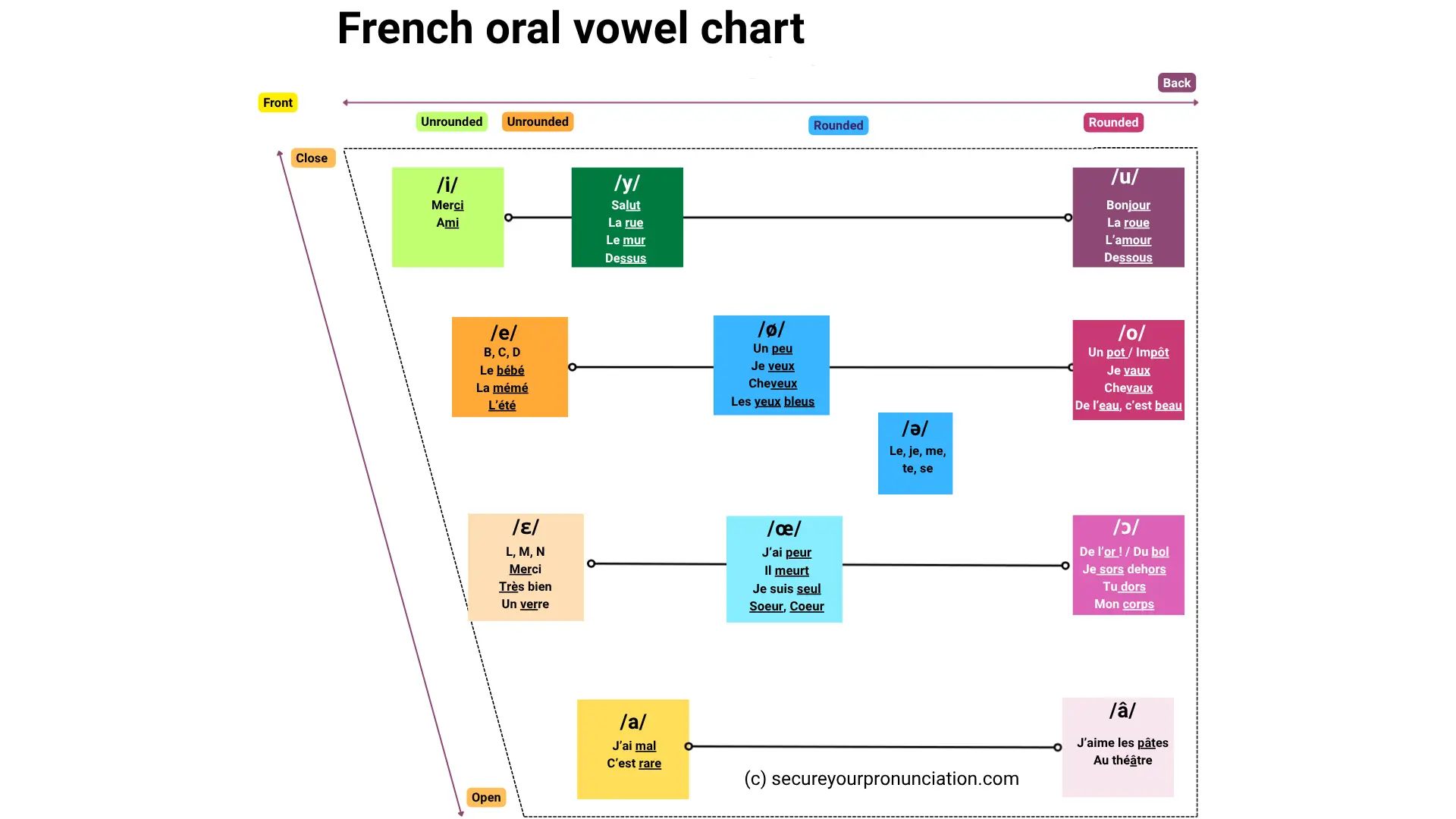
How to read this chart
Horizontal axis (left to right): the tongue pulls back and the lips round more and more.
On the left, front vowels are produced with the tongue forward and unrounded lips.
On the right, back vowels are produced with the tongue back and fully rounded lips.
Vertical axis (top to bottom): the jaw opens progressively.
At the top, close vowels are produced with a nearly closed jaw and a high tongue.
At the bottom, open vowels are produced with a wide-open jaw and a low tongue.
👉 Tip: practice your scales one axis at a time, moving slowly from vowel to vowel.
6.French tongue twisters for articulation
As I’ve already suggested in other articles, you can warm up with tongue twisters.
Some classic French tongue twisters are used by radio journalists, lawyers, and other professional speakers to sharpen their diction and articulatory precision.
Here are a few:
Tongue twisters for /s/, /ʒ/, and /ʃ/
Je cherche Serge. Suis-je bien chez ce cher Serge ?
Tongue twisters for /s/, /z/, /ʒ/, and /ʃ/
Seize chaises sèchent.
Douze douches douces.
Seize cents jacinthes sèchent sur six cent seize jolies chaises sèches.
Tongue twisters for /ʒ/, /e/, and /ə/
Juste juge, jugez le jeune Jean jeudi.
Justin juge les jeunes gens les jeudis.
Tongue twisters for /s/ and /ʃ/
Classic tongue twister:
Un chasseur sachant chasser sait chasser sans son chien de chasse.
Variation:
Un chasseur qui chassait fit sécher ses chaussettes sur une souche sèche.
Other tongue twisters are better suited for working on French sounds that don’t exist in your native language.
Feel free to invent your own tongue twisters… you’ll remember them even better that way!
7. Reading aloud with exaggerated articulation
Finally, read a simple text slowly, exaggerating every syllable. This will help strengthen your upper speech muscles and build your stamina.
What feels exaggerated to you might, in fact, sound natural…
At first, reading aloud for 2 minutes will feel long, but over time you’ll extend your reading-aloud sessions.
More ways to keep practicing your French pronunciation
Elsewhere on this blog, you’ll find other ideas to keep working on your French pronunciation.
I’m thinking of the following articles (still in French):
Final thoughts on French articulation
I hope all these ideas and tips give you ways to work on your articulation as regularly as possible.
If you need help, feel free to book a call to talk through your needs.
See you soon!